
EPFO Anywhere Service 2026: No More Local Office Rule
If you’ve read that EPFO scrapped its jurisdiction rule and you can now walk into any office in the country to sort out your PF, pump the brakes for a second. That’s not quite what happened — and knowing the real mechanism will save you a wasted trip.
Here’s what’s actually verified, straight from government records.
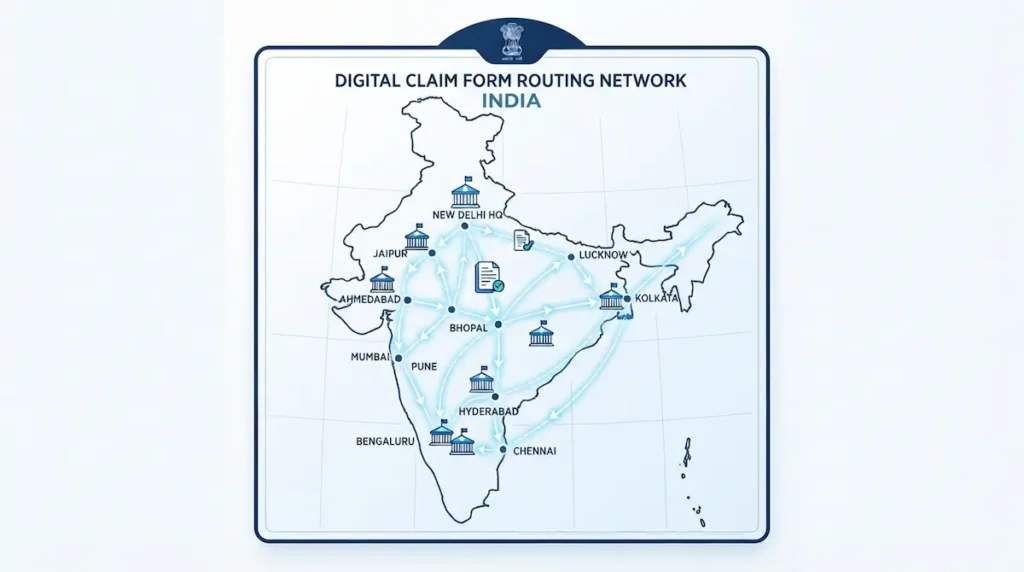
The Real Story: Multi-Location Claim Settlement
In June 2020, EPFO launched something called the multi-location claim settlement facility. The first batch was processed for the Gurugram region on June 10, 2020. The idea was simple: instead of your claim sitting in a queue at your one designated regional office, EPFO can now route it to any regional office in the country that has spare processing capacity.
This wasn’t a customer-convenience gimmick. It came out of a real operational problem. During the pandemic, offices in Mumbai, Thane, Haryana, and Chennai were drowning in claims — partly because of the newly introduced COVID-19 advance withdrawal — while running on skeleton staff. Meanwhile, other regional offices had spare capacity. EPFO’s fix: stop tying a claim to the geography of the member, and let it flow to wherever there’s bandwidth.
A May 8, 2024 circular pushed this further, formally linking 19 Regional Offices with 36 Collaborating Regional Offices (CROs), following discussions at a zonal review conference chaired by the Central Provident Fund Commissioner. The circular also placed responsibility on the Designated Regional Office (DRO) to keep member and establishment data clean — no pending reconciliations, no short-balance issues — before handing a case over to a CRO for processing.
What this covers: provident fund withdrawal, pension claims, partial withdrawal (advances), and transfer claims — all four major claim types can be routed this way.
What This Does NOT Mean
This is the part most coverage gets wrong, so let’s be precise:
- It does not mean you can walk into any physical EPFO office for offline help. The multi-location facility governs back-end online claim processing — which office’s staff handles your digital claim — not which office you can physically visit for in-person grievance redressal.
- It doesn’t replace your “linked” office for every service. Physical services like document verification in specific disputed cases, or certain employer-related establishment matters, still often route through your original jurisdiction.
- If a source tells you to “just visit your nearest EPFO office regardless of location” for a walk-in issue, treat that as unconfirmed until you check with EPFO directly. It isn’t backed by any PIB release or official circular as of this writing.
If you need offline help, the safest move is still checking your correct jurisdiction using EPFO’s official “Know Your PF Office” tool at epfindia.gov.in before you travel anywhere.
Why This Actually Matters for Your Claim
The real value of multi-location processing shows up in the numbers. Auto and multi-location processing together have compressed timelines dramatically:
- FY 2024-25: EPFO crossed 5 crore claim settlements, up from 4.45 crore the year before
- Auto-settlement (zero human intervention) claims nearly doubled to 1.87–2.34 crore depending on the reporting period, versus 89.52 lakh in FY 2023-24
- 59% of all advance claims in FY 2024-25 were auto-settled, up from 31% the previous year
- In just the first 2.5 months of FY 2025-26, EPFO had already auto-settled 76.52 lakh claims — 70% of all advance claims processed in that window
- Only 8% of transfer claims now require member and employer attestation, down sharply after the simplified transfer claim application was introduced
The multi-location facility and auto-settlement aren’t the same system, but they work together: multi-location distributes the workload across offices, and auto-settlement removes the human bottleneck entirely for eligible claims (illness, education, marriage, housing advances).
What You Should Actually Do With This Information
- Keep your UAN Aadhaar-verified. Multi-location and auto-settlement both depend on clean, verified data. An unverified UAN is the single biggest reason claims still get manually reviewed regardless of which office handles them.
- Don’t chase a specific office. If your claim is delayed, it’s not necessarily stuck at “your” regional office — it may already be sitting with a collaborating office elsewhere. Check status on the Unified Member Portal rather than calling your local office.
- For transfer claims, check if you fall in the 92% majority that no longer needs employer attestation — this alone eliminates the most common delay point people report.
- For genuine offline/grievance issues, use the EPFiGMS grievance portal first. It’s the documented, trackable channel — not an assumption about walk-in flexibility that isn’t officially confirmed.
Also read: ₹7,500 EPS Pension Hike: Truth or Fake News 2026?
The Bottom Line
EPFO has genuinely dismantled jurisdiction as a bottleneck — but on the back end, not the front counter. Your claim can now be processed by whichever office has capacity, which is a real and measurable improvement in settlement speed. What hasn’t changed, at least not on any verified record, is the assumption that you personally can show up at any office in the country for offline service. Treat that claim with skepticism until EPFO confirms it directly, and rely on the portal and grievance system for anything that needs human follow-up.